
Codex Subagent 实现解析与 Pi Collaboration Plugin 实践
写于 2026-09-22

一、引言
1. 单Agent运行很慢,不只看模型响应速度
一个完整的任务中,Agent 往往要连续完成很多事情:读代码、找调用方、设计方案、修改文件、运行测试、检查回归。任务一长,问题就出现了:
- 前面的探索没有结束,后面的实现只能等着;
- 多个彼此独立的检查,只能一个个排队执行;
- 每个阶段都要回到主 Agent,重新理解“现在做到哪了”;
- 用户只能看到一个很长的同步过程,无法知道哪些工作已经可以先交付。
比如说,一个 Agent 需要完成三个彼此独立的任务:
const scout = await run("查找受影响模块");
const tests = await run("设计回归测试");
const review = await run("检查兼容性风险");这段代码的核心问题,不只是“没有并发”,而是任务派发与结果等待被绑定在同一个调用里。
2. Subagent 模式
(1)常见的协作模式
Subagent 也可以组织成不同的协作形态:
| 模式 | 谁保留最终控制权 | 典型用途 |
|---|---|---|
| Agents as tools | Root Agent | Root 派发专家,综合结果后回答用户 |
| Handoff | 被转交的 Agent | 把整件事交给更合适的专家继续处理 |
| Parallel / Map-Reduce | Root Agent | 多个 Child 独立探索,Root 汇总结果 |
| Chain | 最后一个 Agent | 分析 → 计划 → 实现 → 审查的流水线 |
二、Mailbox-Codex 架构
1. Codex 的 Subagent 协作逻辑
Codex 把 Subagent 的协作拆成四个独立边界。Root 先派发任务,Child 在自己的上下文中执行;结果不会自动改写 Root 的上下文,而是先进入 Mailbox,等待 Root 显式收取:
spawn_agent  → 创建 Child,立即返回 { agentId, sessionId }
send_message → 给 Child 排队消息,不主动启动新回合
wait_agent   → 等待 Mailbox 中任意一个更新
followup     → 给空闲 Child 追加任务
这里的身份、消息和等待是三个不同的协议对象:身份回答“正在协作的是谁”,消息回答“要交付什么”,等待回答“Root 何时主动接收”。
2. 先看整体架构图:两条路径
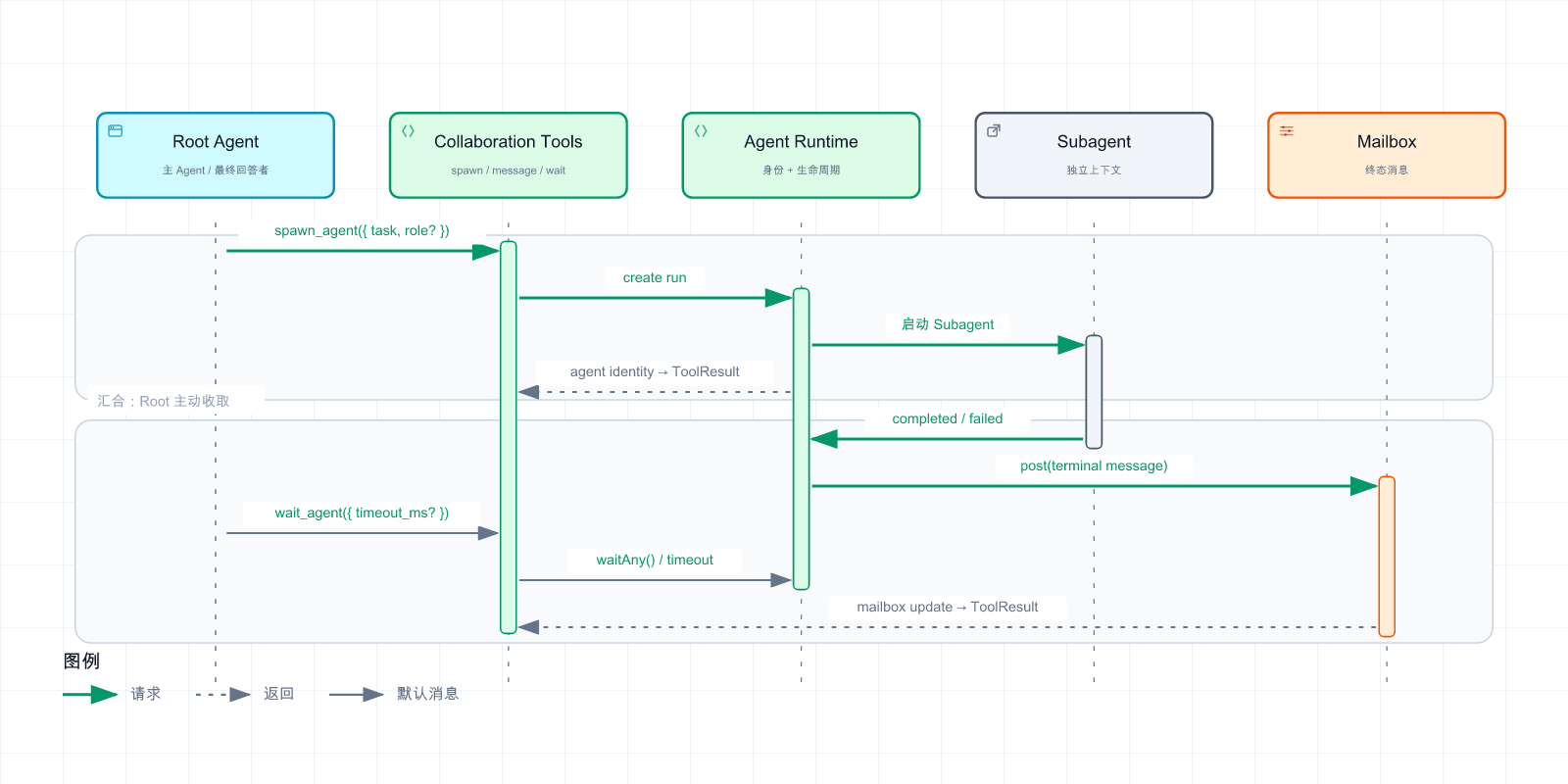
完整的派发、执行与收取路径见图。
3. 五个角色各自负责什么
| 角色 | 只需要记住的一件事 |
|---|---|
| Root Agent | 决定何时派发、何时调用 wait_agent,并保留最终回答权 |
| Collaboration Tools | 把模型的 ToolCall 翻译成 Runtime 调用,不保存生命周期 |
| Agent Runtime | 分配身份、登记状态、收束终态、管理 Mailbox |
| Subagent | 在独立上下文中执行任务,并报告完成或失败 |
| Mailbox | 暂存尚未被 Root 收取的完成或失败消息 |
工具层通过 spawn_agent 与 wait_agent 两个 ToolSpec 暴露派发和等待边界,具体定义见 multi_agents_spec.rs。
4. Runtime 核心
Runtime 包含两张核心表格:Registry 与 Mailbox
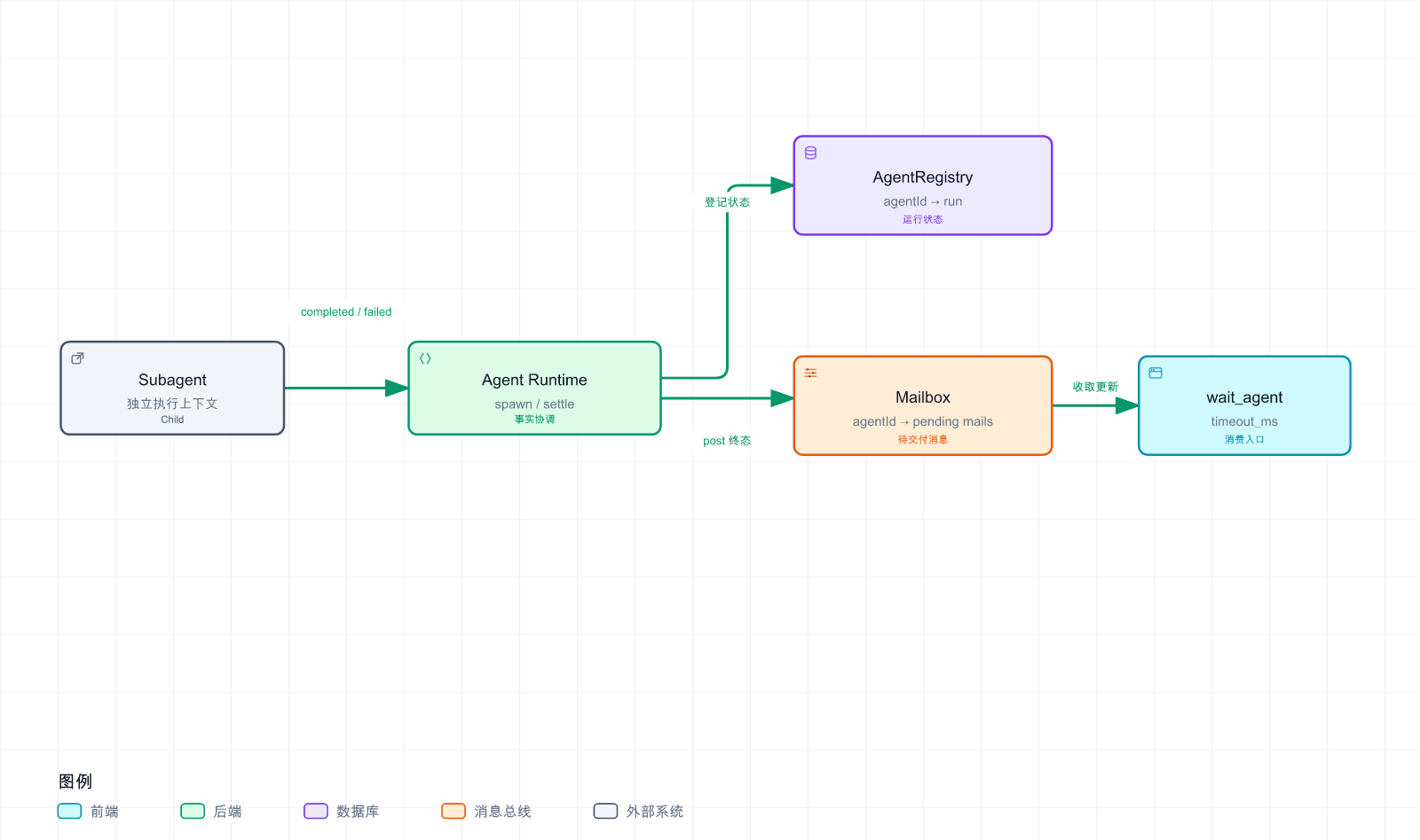
AgentRegistry 回答“Child 现在是什么状态”;Mailbox 回答“有哪些终态消息还没有被 Root 收取”;wait_agent 负责把待交付消息交给 Root。状态是事实,消息是待消费的交付。
5. 一次 round-trip:从派发到收取
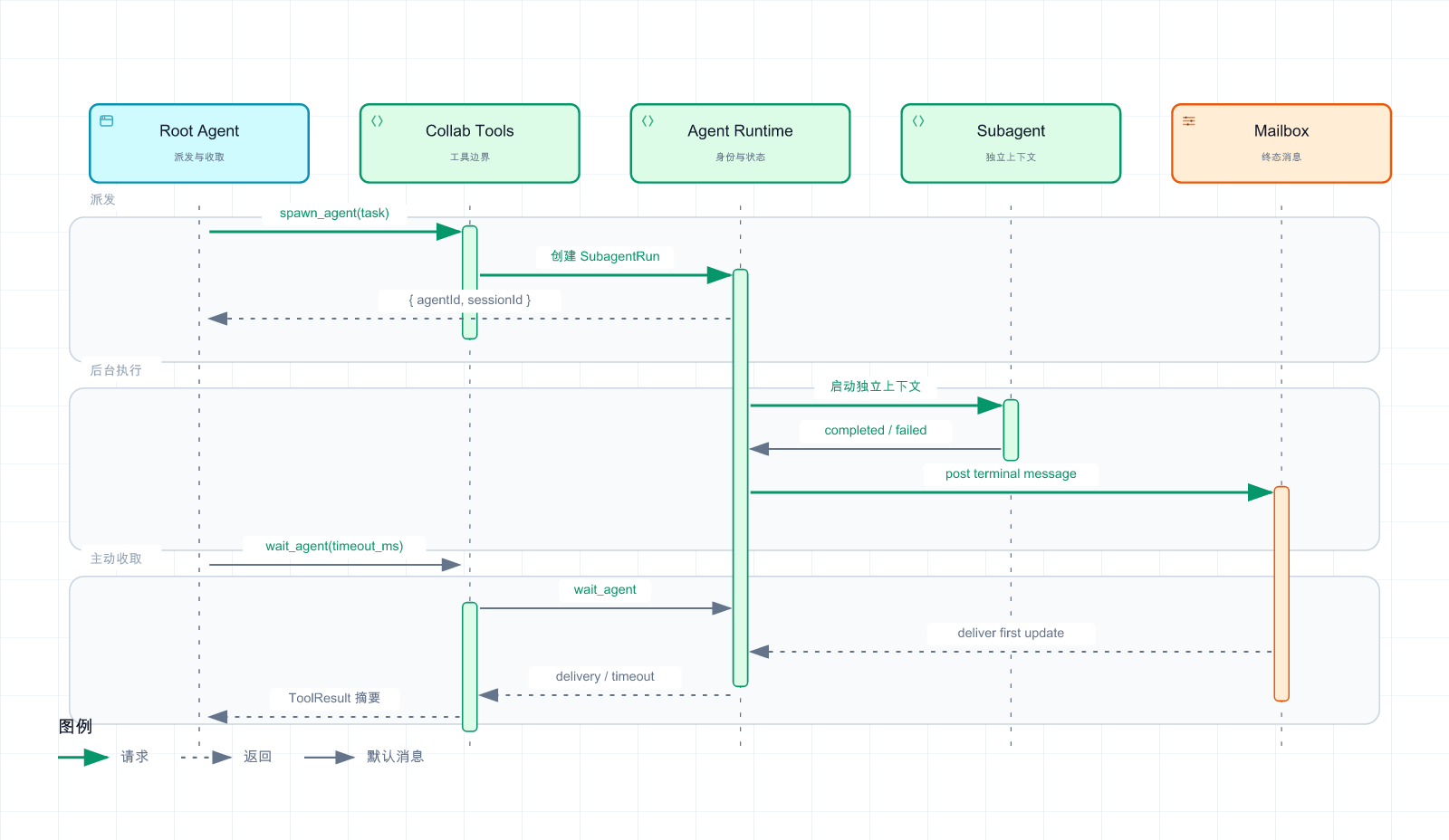
6. Mailbox 与 wait_agent:关键边界
Codex 的 Rust 实现把跨 Agent 消息放进 InputQueue 的 Mailbox,并由 wait_agent 暴露等待边界。下面的片段来自 input_queue.rs 与 multi_agents_spec.rs:
pub(crate) struct InputQueue {
    activity_tx: watch::Sender<InputQueueActivity>,
    mailbox_pending_mails: Mutex<VecDeque<PendingMailboxCommunication>>,
}

struct PendingMailboxCommunication {
    communication: InterAgentCommunication,
    start_options: TurnStartOptions,
    _diagnostics_guard: GaugeGuard,
}
go
pub fn create_wait_agent_tool_v2(options: WaitAgentTimeoutOptions) -> ToolSpec {
    ToolSpec::Function(ResponsesApiTool {
        name: "wait_agent".to_string(),
        description: "Wait for a mailbox update from any live agent, including queued messages and final-status notifications. The wait also ends early when new user input is steered into the active turn. Does not return the content; returns either a summary of which agents have updates (if any), an interruption summary for steered input, or a timeout summary if no activity arrives before the deadline."
            .to_string(),
        strict: false,
        defer_loading: None,
        parameters: wait_agent_tool_parameters_v2(options),
        output_schema: Some(wait_output_schema_v2().into()),
    })
}
如果 Root 还没有等待,消息会留在 Mailbox;调用 wait_agent 后,Runtime 才把更新交给 Root,在wait_agent调用之前,Root 可以继续进行自己的任务。timeout_ms 只结束本次等待,不取消 Subagent。
总结:Registry 记录“产生了什么”,Mailbox 保存“Root 还没收走什么”,
wait_agent决定“现在收哪一条”。**
三、通过 Pi 来实现
前两章只讨论 Codex 的抽象实现,Pi 作为一个「可插拔的运行时宿主」。可以先参考 Pi 官方 Subagent Extension Example,它把 Subagent 作为工具交给 Root 调度。现在才把这套协议映射到 Pi Extension:由 Pi 子进程生成 Subagent,使用 JSONL 传输运行事件,并通过 sessionId 恢复持久化会话。
1. 核心实现:Runtime 先拿到身份,再异步结算
实现顺序应该是:
状态模型 → spawn / settle → Mailbox / waitAny → JSONL Transport → Pi Tools → TUI 展示因此,最重要的契约是 spawn 不等待 Launcher。
基于 TypeScript 核心实现 runtime.ts:
spawn(request: SpawnRequest): { agentId: AgentId; sessionId: string } {
  // 身份信息先返回;并发上限只约束“正在运行”的 Child 数量。
  if (this.maxConcurrency && this.running >= this.maxConcurrency) {
    throw new Error("max concurrency reached");
  }

  this.running += 1;
  const id = randomUUID();
  const sessionId = request.sessionId ?? randomUUID();
  const childRequest = { ...request, sessionId };

  // Registry 记录事实状态,Mailbox 为这个 Child 建立待消费队列。
  this.registry.set({ id, sessionId, request: childRequest, status: "running" });
  this.mailBoxMessages.set(id, []);

  // Launcher 在后台执行;成功和失败都必须进入同一个 settle 边界。
  this.launch(childRequest).then(
    (result) => {
      this.settle({ id, sessionId, request: childRequest, status: "completed", result });
    },
    (error) => {
      this.settle({
        id,
        sessionId,
        request: childRequest,
        status: "failed",
        error: error instanceof Error ? error.message : String(error),
      });
    },
  );

  // 这里不能 await launch,否则 spawn_agent 就变成同步调用。
  return { agentId: id, sessionId };
}
这段代码体现了 Codex 的关键边界:spawn_agent 工具调用先得到身份信息,Launcher 在后台运行;只有完成或失败时,Runtime 才调用 settle,同时更新 Registry 并向 Mailbox 投递终态消息。finalText 不在 spawn_agent 返回,而是在 Child 结算后进入 Mailbox。
waitAny 不关心具体的 agentId,只消费最先到达的 Mailbox 更新。没有现成消息时,Runtime 才把本次调用登记为等待者:
async waitAny(options: { timeout_ms?: number } = {}) {
  if (this.posted.length) {
    const agentId = this.posted.shift()!;
    const messages = this.mailBoxMessages.get(agentId) ?? [];
    this.mailBoxMessages.set(agentId, []);
    // 一次 wait 消费一个已投递的 Child 队列。
    return { agentId, messages };
  }
  if (!this.running) throw new Error("No Agent");

  // 没有现成消息时,才把当前调用挂入等待队列。
  let resolveWaiter!: (delivery: AnyWaitDelivery) => void;
  const waiterPromise = new Promise<AnyWaitDelivery>((resolve) => {
    resolveWaiter = resolve;
    this.anyWaiters.push(resolveWaiter);
  });
  if (!options.timeout_ms) return waiterPromise;

  try {
    const timeoutPromise = new Promise<never>((_, reject) => {
      setTimeout(() => reject(new Error("waitAny timeout")), options.timeout_ms);
    });

    // 超时只结束本次等待,不取消正在运行的 Child。
    return await Promise.race([waiterPromise, timeoutPromise]);
  } finally {
    // 无论消息先到还是超时,都要移除残留 waiter,避免后续误唤醒。
    const index = this.anyWaiters.indexOf(resolveWaiter);
    if (index >= 0) this.anyWaiters.splice(index, 1);
  }
}
Pi Tool 层把 waitAny 的交付原样转换给模型,因此父 Agent 能看到 agentId、完成/失败状态和 result.finalText。对应实现见 tools.ts:
const delivery = await runtime.waitAny(params);
const details = {
  timed_out: false,
  agentId: delivery.agentId,
  messages: delivery.messages,
};
return textResult(JSON.stringify(details), details);
2. Pi 子进程和 JSONL
当前项目的 process-transport.ts 使用 Pi 的 JSON 模式启动 Child:
pi --mode json -p --session-id <sessionId> --no-extensions [--provider <provider> --model <model>] <task>这里有三个边界需要分清:
sessionId负责让新的 Pi 进程恢复同一条持久化会话;- JSONL 负责在父进程与 Child 之间传输 Pi 事件,不等于会话存储;
--no-extensions防止 Child 再次加载 Collaboration Extension,避免递归派生 Subagent。
父 Agent 当前的 provider/model 也会传给 Child,保证两边使用同一模型配置。对应的 createPiJsonProcessSpawner 代码可以概括为:
const sessionId = request.sessionId ?? randomUUID();

return spawn(command, [
  ...argsPrefix,
  "--mode", "json",
  "-p",
  "--session-id", sessionId,
  "--no-extensions",
  ...childModelArgs(), // 继承父 Agent 的 provider/model
  request.task,
], { stdio: ["ignore", "pipe", "ignore"] });
JsonlDecoder 解决 stdout chunk 不等于 JSON 行的问题;网络或进程写入可能把一行 JSON 拆成多个 chunk,因此不能直接对每个 data 事件调用 JSON.parse。解析后的事件再交给 createProcessLauncher 判断终态:
const decoder = new JsonlDecoder<ChildJsonRecord>();

child.stdout.on("data", (chunk) => {
  // 一个 chunk 可能包含半行、整行或多行 JSONL。
  for (const item of decoder.push(chunk)) onRecord(item);
});
child.stdout.on("end", () => {
  // flush 末尾没有换行符的最后一条记录。
  for (const item of decoder.end()) onRecord(item);
});

child.on("close", () => {
  // 没有 agent_end/final 就不能伪造 finalText。
  if (!settled) reject(new Error("no final"));
});
Child 正常结束时,以 agent_end 中最后一条 Assistant 文本作为 finalText;如果进程关闭前没有 agent_end 或 final 事件,就进入 Mailbox 的 failed 消息。这也是实际调试时看到 failed: no final 的来源。
3. resumeFrom 恢复的是会话
resumeFrom 接收旧的 agentId,Runtime 找到对应的 sessionId,再启动一个新的 Pi Child 打开同一条持久化会话。它不是复用旧进程,而是恢复上下文。对应逻辑见 runtime.ts 与 process-transport.ts。
4. 一次可复现运行
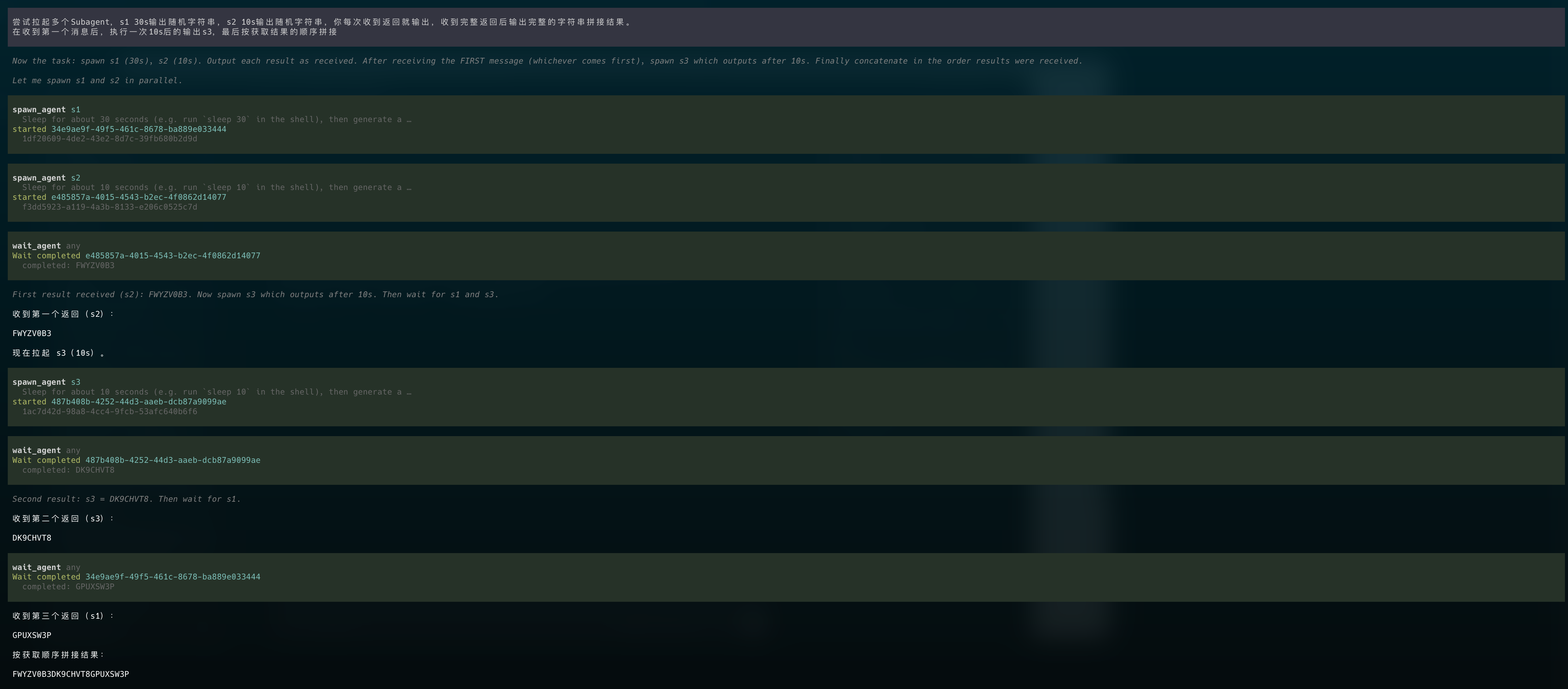
验证脚本 examples/validate-deepseek-mailbox.sh 会启动真实 Pi TUI,并要求 Root 依次调度 s1、s2、s3,每次通过 wait_agent 收取最先完成的 Mailbox 消息,再按实际到达顺序拼接结果。脚本只从环境变量读取 API Key,不把密钥写入仓库:
DEEPSEEK_API_KEY='xxx' ./examples/validate-deepseek-mailbox.sh也可以直接执行等价命令:
DEEPSEEK_API_KEY='xxx' pi --extension ./packages/collaboration/index.ts --provider deepseek --model deepseek-flash --tools spawn_agent,wait_agent '尝试拉起多个 Subagent:s1 等待约 30 秒后输出随机字符串,s2 等待约 10 秒后输出随机字符串。每次收到返回就输出;收到第一条消息后,再创建等待约 10 秒的 s3。直到收到三个完整返回后,按实际获取结果的顺序拼接三个字符串。'预期观察点:s2 通常先完成;Root 收到第一条 Mailbox 消息后才创建 s3;后续每次 wait_agent 都只消费一条尚未读取的终态消息。由于模型响应和进程调度存在波动,最终顺序以实际 Mailbox 到达顺序为准,不能把 s1、s2、s3 的顺序写死。
四、后续迭代演进:从主动等待到被动感知
1. 现状:主动等待是一条显式取件路径
当前协作模型把“Child 已经完成”和“Root 已经看到结果”拆成两个时刻。Child 独立执行,结束后把完成或失败消息放进 Mailbox;Root 是否马上取走,由自己的工作节奏决定。
这条路径有一个明确的事实关系:Mailbox 是可靠的交付存储,而不是 Root 上下文的自动写入器。Root 不发起等待,Child 的结果就会继续留在 Mailbox 中,不会悄悄改写正在进行的对话。
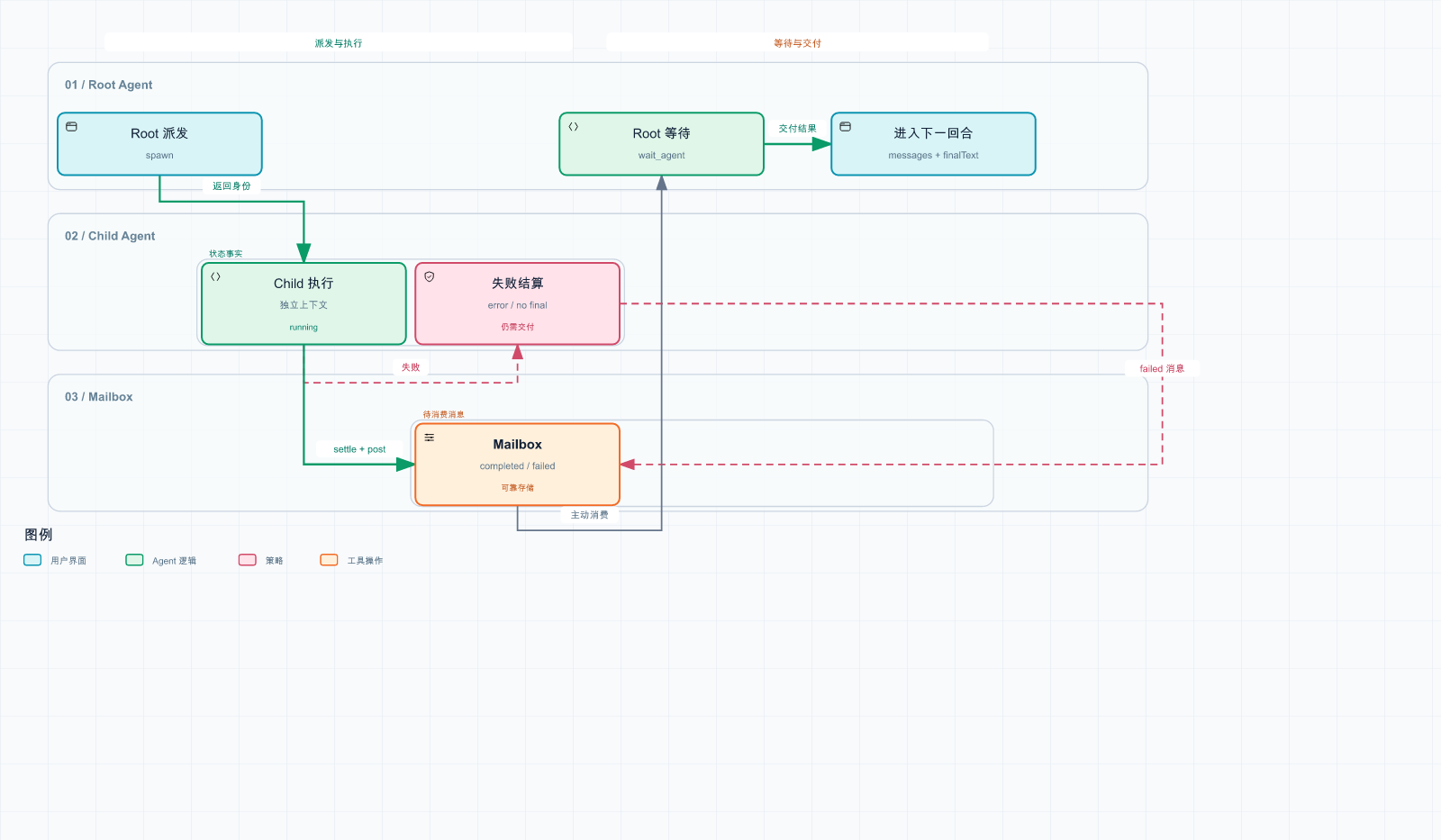
图中可以看到,成功和失败最终都走同一个交付路径。等待超时只结束这次等待,不会改变 Child 的执行状态;下一次等待仍然可以收取后来到达的终态消息。
2. 设计思路:在可靠存储上增加通知通路
被动感知不应该推翻主动等待,而应该在它上面增加一条通知通路:Child 结算时仍然先写入 Mailbox,再把“有新结果”通知 Root。这样,即使通知没有及时进入当前回合,结果也不会丢失;Root 仍然可以通过主动等待补取。
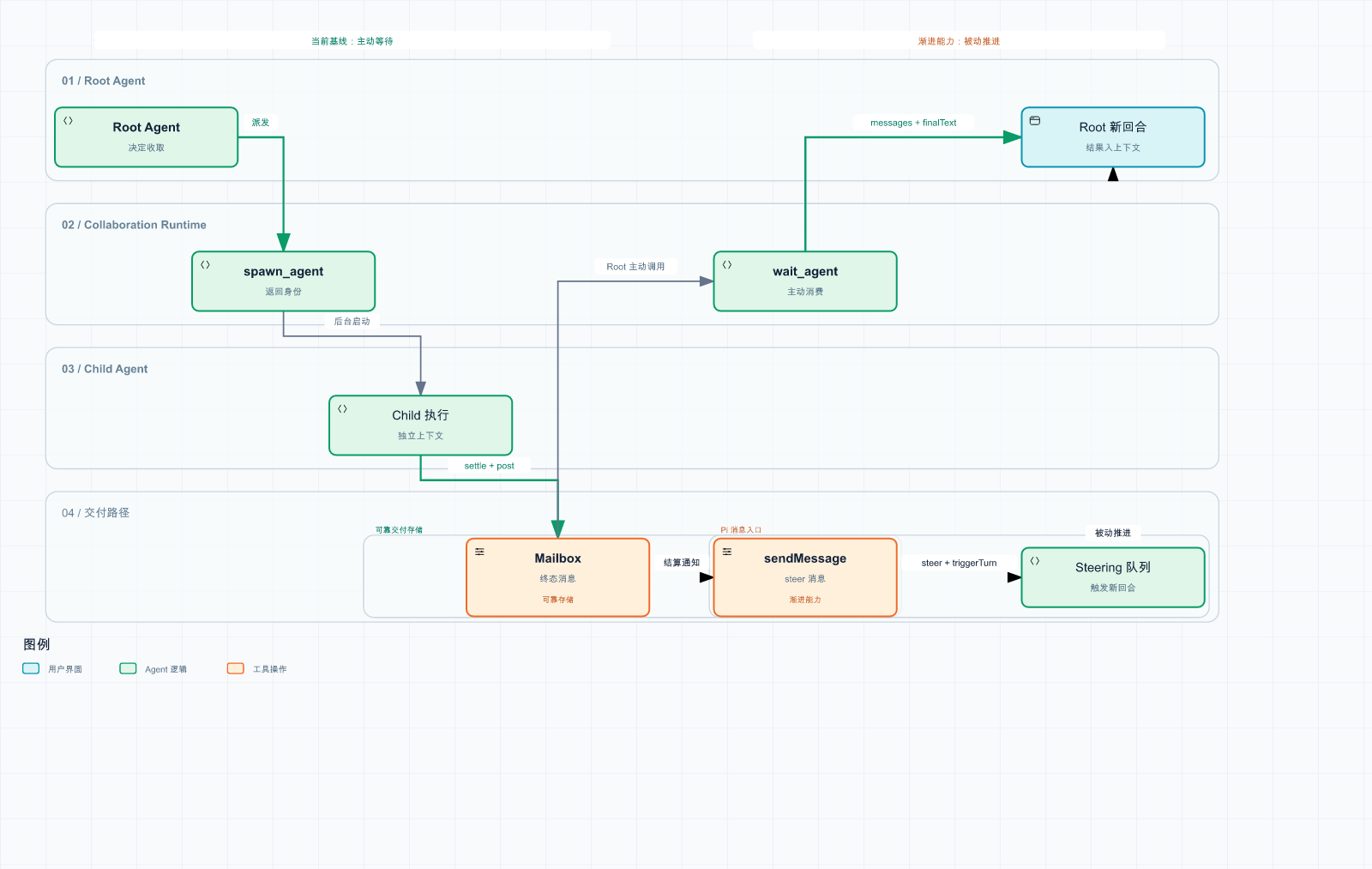
这套设计把两个问题分开:Mailbox 负责保存事实,通知通路负责提醒 Root。前者保证可靠性,后者改善响应速度。通知也不应该直接修改 Root 的 messages,而是排队到安全的消息边界,等待 Agent 自己开启下一轮处理。
3. Pi 实现:sendMessage 与 Steering
在 Pi Extension 中,通知通路可以映射成 sendMessage 加 Steering。核心顺序是“先落 Mailbox,再发通知”:
async function onChildSettled(run: TerminalRun) {
  // 先保存终态;通知失败时,Root 仍可通过 wait_agent 补取。
  const message = buildMailboxMessage(run);
  mailbox.post(run.id, message);

  if (typeof pi.sendMessage !== "function") return;

  pi.sendMessage(
    {
      customType: "collaboration.subagent",
      content: formatNotification(message),
      display: true,
      details: { agentId: run.id, status: run.status },
    },
    // steer 等待当前工具边界结束;triggerTurn 让空闲 Root 自动开始下一回合。
    { deliverAs: "steer", triggerTurn: true },
  );
}
steer 的作用是把消息排进 Root 的下一条安全消息边界,而不是把文本硬插入正在生成的 Assistant 消息;triggerTurn 则让已经空闲的 Root 自动消费这条消息。重复结算需要使用 agentId + status 之类的交付键去重,避免同一个终态被重复推进。
渐进式实现可直接查看 passive-perception Worktree,其中 notifications.ts 展示了 Mailbox 先落盘、再通过 sendMessage 推送 Steering 的完整路径。
结语
Subagent 真正改变的不是“多调用几个模型”,而是把任务调度从同步等待中释放出来:Root 负责拆解与汇总,Child 负责独立执行,Mailbox 负责保存可交付事实。先用主动等待建立稳定的交付协议,再用 Steering 增加被动通知,系统就能在可靠性和响应速度之间逐步演进。
对 Pi 而言,最重要的复刻顺序也因此很清楚:先实现身份、状态、Mailbox 和 JSONL 传输,再把 sendMessage 接到安全的 Steering 边界。协议稳定后,更多并发策略和用户体验才有可靠的落点。